
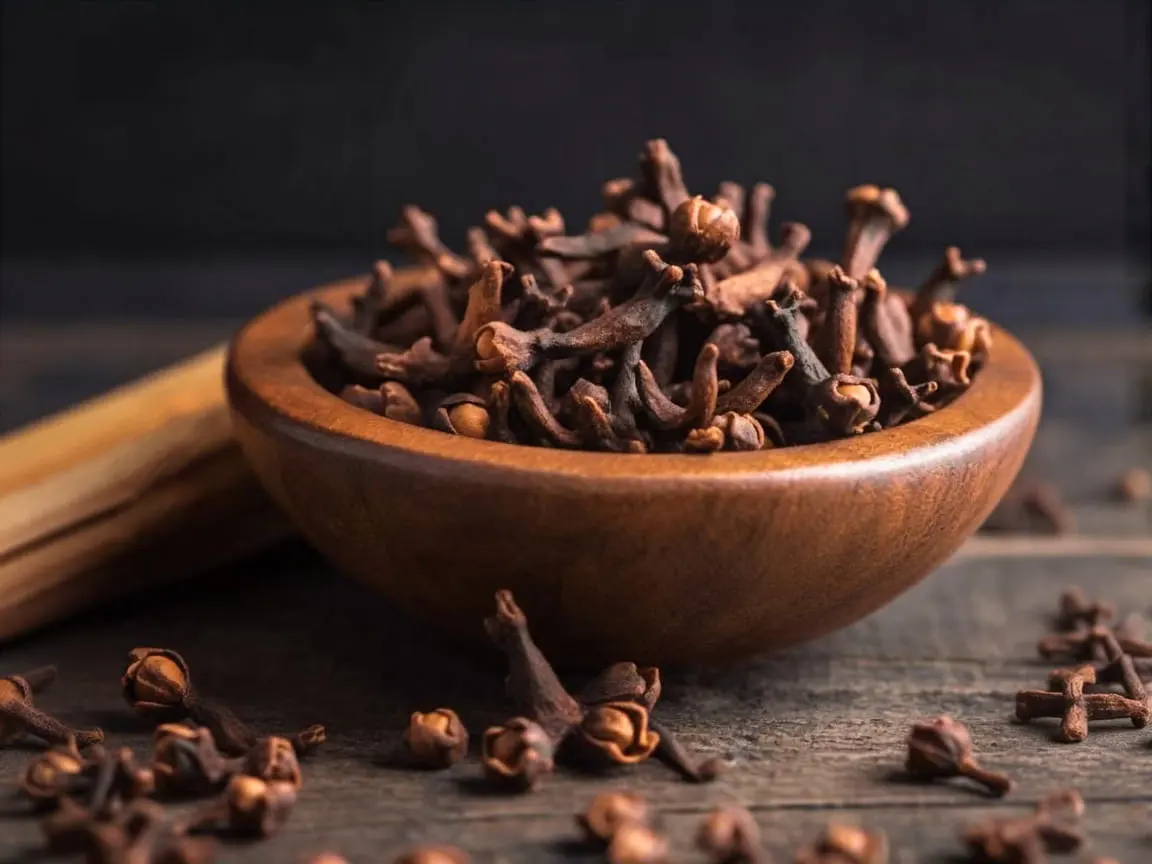
Large and small cloves are size grades, not varieties. Large buds are picked at mid-flowering: 1.5–2 cm long and 0.5–0.8 cm wide, with a rounded head and dense oil glands. Their aroma is sweet and rich, with a clean finish. Small buds come from early or late flowering: 1–1.5 cm long, with narrower heads, fewer oil glands and a weaker aroma that fades faster, sometimes with a bitter edge. They sell 20–30% lower and suit powder, oil extraction and price-led foodservice. Mother cloves, the mature fruit, are a separate and cheaper product.
CLOVE QUALITY GUIDE
How to Recognise Good Whole Cloves
Good whole cloves are plump, glossy, red-brown buds that release a little oil when you squeeze the head and smell strongly sweet. Large buds, over 1.5 cm, carry more oil and sell 20–30% above small buds. Madagascar's large buds are the benchmark; Indonesian cloves, which we supply, are darker and sharper, and cost less.
By Fu Yang Updated
PRACTICAL TIPS
Five checks on a clove sample
| Check | Good sign | Warning sign |
|---|---|---|
| Size | Mostly over 1.5 cm, with a round, full head. | Many buds of 1.2 cm or less with narrow heads: a small-bud grade, or a mixed lot. |
| Squeeze the head | A little clear oil and a strong, sweet aroma with mild spice. | Dry, hard and oilless: old or over-dried. |
| Colour | Natural red-brown lustre. | Evenly bright or whitish with a sharp, sour smell (sulphur); black and stale (old or scorched). |
| Feel | Crisp and dry. | Soft buds have taken up moisture. |
| Top, middle and bottom of the bag | The same quality all the way through. | Broken buds, stems, sand or salt layered in the middle or at the bottom. |
Large buds and small buds
Madagascar and Indonesian cloves
Madagascar's Sava region grows the benchmark: large buds of 1.6–2 cm, plump and glossy red-brown, that can release clear oil when squeezed, with a sweet, floral, lingering aroma. Indonesian large buds from Maluku are 1.4–1.7 cm, darker and less glossy, with sharper heat, less sweetness and a slight bitterness; small buds from Sulawesi are 0.9–1.2 cm. Madagascar stems are shorter and thicker, Indonesian ones finer and longer. Same-grade Madagascar cloves usually trade 15–25% above Indonesian ones.
Our current supply is Indonesian, declared for each lot from its import records. If your specification requires Madagascar cloves, tell us before you order.
Harvest and drying
Madagascar's main crop runs from September to December, peaking in October and November, with a smaller crop of smaller buds from January to March. Indonesia picks mainly from July to October, with a smaller crop from February to April. Large buds dominate the middle of each season; early and late picking gives more small buds.
Buds are picked by hand, destemmed and sun-dried on mats for 3–5 days to 12–13% moisture. Drying above about 50 °C drives off clove oil. Some low-grade cloves are fumigated with sulphur to look brighter and weigh more; they trade about 20% below untreated cloves and risk sulphur dioxide residues.
Why buy Indonesian cloves through Yulin?
If you need a full container of one clove grade, buying at origin can be the better route, and we will say so. Buying through Yulin makes sense when you need cloves together with other spices in one container, a smaller quantity, sorting to a size grade, or a sample to approve before you commit. China imports almost all the cloves it uses, and Yulin is its largest distribution centre, so several grades are usually in stock.
Whatever the route, the origin stays Indonesian on every document. Sorting and packing in China do not change where cloves were grown.
Price index, September 2026
Yulin market prices as an index, with Indonesian grade-1 large buds = 100; not offers. At origin, Madagascar AAA large buds cost about 20% more than Indonesian grade-1 large buds. Madagascar large buds fell by about a third from 2023 to 2024 and recovered slightly in 2025. Clove trees take 6–8 years to bear, so supply adjusts slowly and prices move in long cycles.
Indonesian grade-1 large buds
100
Madagascar selected large buds
about 115
Indonesian small buds
about 75–80
Broken buds
about 50
QUICK CHECK
When you compare commercial samples
- Sample reference and date
- Origin and size grade (large or small buds)
- Close photographs of heads and stems
- Whole-bud rate, stems and foreign matter
- Moisture, volatile oil and SO₂ results
- Packing and proposed quantity
Use the same lighting, sample weight and checklist for every comparison so appearance does not hide a weaker sample.
BUYER QUESTIONS
Frequently asked questions
Are large and small cloves different varieties?
No, they are size grades of the same flower buds. Large buds are picked at mid-flowering and carry more oil; small buds come from early or late picking.
How can I spot a mix of large and small buds?
Take ten buds from each of several bags. If three or more are small, narrow-headed buds, ask for the size grade to be checked with a sieve before you approve the lot.
Where are your cloves from?
Indonesia, declared for each lot with its import and batch records. Sorting and packing in China do not change the origin.
Why do Madagascar cloves cost more?
Their large buds are plumper and oilier, with a sweeter, more floral aroma. Supply also depends on one main region and one main season, so weather and logistics move the price.
How should cloves be stored?
Sealed, cool and away from other foods, because clove aroma is strong and spreads. Dry buds stay crisp; soft buds have taken up moisture.