
PEPPER GUIDE

Black Pepper: Hainan, Vietnam and Indonesia, and What g/L Means

Black pepper is graded first by bulk density: 500 or 550 g/L for Vietnamese grades, and about 580–620 g/L for Hainan's fuller berries. Heavier pepper usually carries more piperine. Hainan, Vietnam and Indonesia each have their own taste and harvest season, so new crop arrives in spring, mid-year and autumn.

By Fu Yang Updated

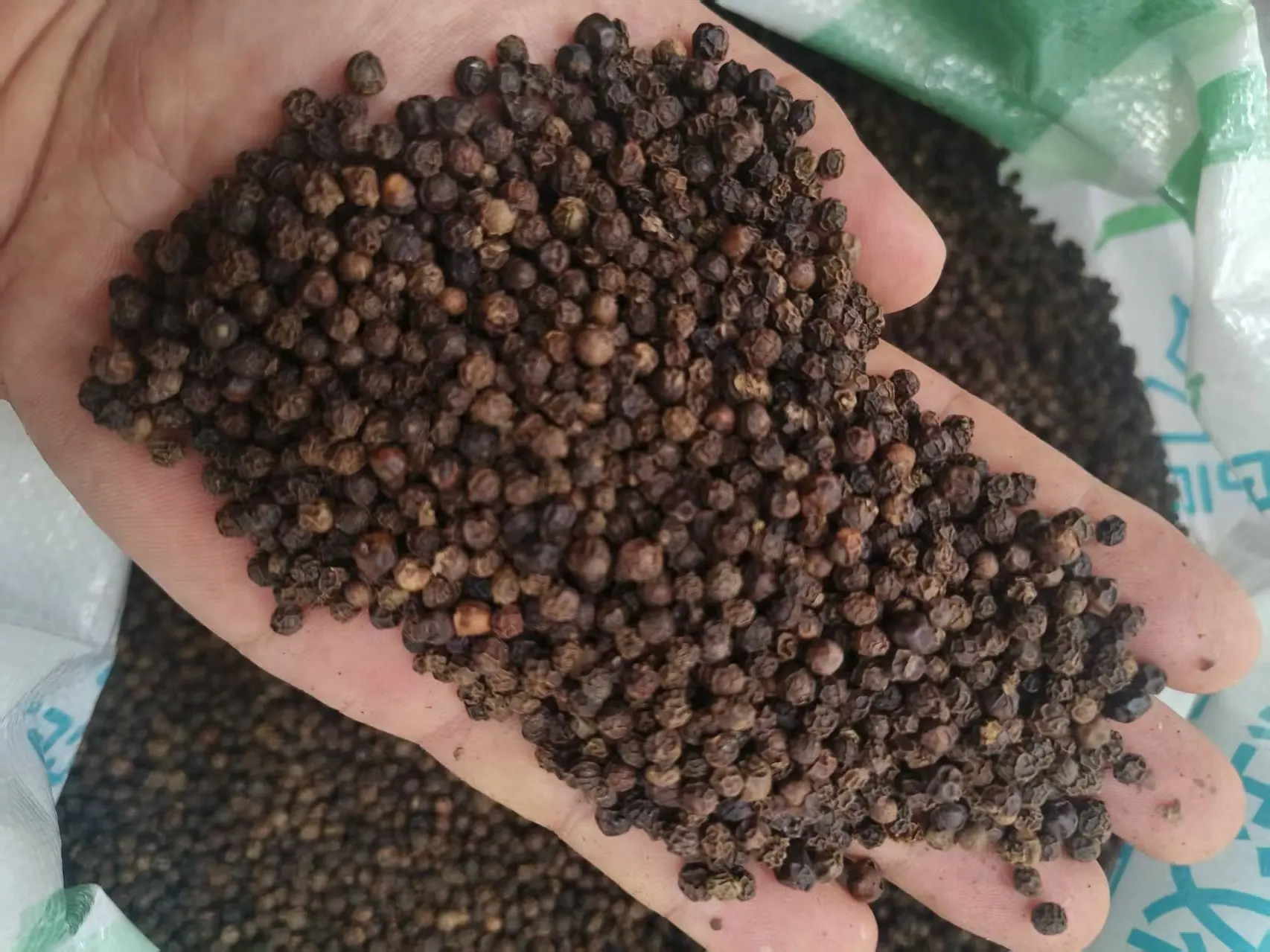
Whole black pepper

PRACTICAL TIPS

Black pepper origins at a glance

Black pepper origins at a glance
OriginBerry and tasteDensity
Hainan, China (Qionghai, Wanning)Large, glossy, aromatic berries with a rounded, lasting heat. Qionghai piperine is reported at about 7%.About 580–620 g/L.
Vietnam, Dak NongUniform, deep black-brown berries; pungent, sometimes pine-like.About 550–590 g/L.
Vietnam, Gia Lai and Dak LakCommon, stable bulk.About 500–550 g/L.
Indonesia, Lampung (Sumatra)Large, thick-skinned berries with woody, citrus notes and a slowly building heat.About 550–580 g/L.
Indonesia, BangkaSmall, thin-skinned berries; mild and less aromatic.About 480–520 g/L.

What 500 and 550 g/L mean

Bulk density is the weight of a litre of pepper. Full berries are heavy; light, hollow berries pull the figure down. Vietnam trades its pepper by density: the 550 g/L grade is sold at moisture of 13% or less, impurities of 0.5% or less, piperine of at least 5.5% and volatile oil of at least 1.8%; the 500 g/L grade at 13.5%, 1%, 5% and 1.5%.

China's standard for black pepper (GB/T 7901-2018) sets grade 1 at impurities of 1% or less, moisture of 13% or less, piperine of at least 5.0% and volatile oil of at least 1.5%. Our whole black pepper reference is at least 550 g/L.

Harvest calendar

Vietnam harvests from March to June, mainly in April and May, with a smaller September–October crop of about a fifth of the year. Indonesia can pick all year, with a peak from July to September (Lampung in July and August, Bangka from August to October). Hainan's main crop runs from mid-September to late November; Wanning comes first, and Qionghai and Haikou about 15 days later. A small April–May Hainan crop sells 10–15% below the autumn crop.

For black pepper, clusters are picked when one or two berries turn from yellow to red. For white pepper, berries are left to ripen fully and the skin is removed.

From berry to black pepper

In China, picked clusters are sun-dried for 3–4 days, threshed once the skins wrinkle, then dried for another 4–6 days to 13% moisture or less. For a more even dark colour, export processors blanch the berries in boiling water for 30–60 seconds before 5–7 days of sun drying. Machine drying at about 55 °C for 24 hours works in any weather, but too much heat costs aroma. Washing, sorting and re-drying for high grades loses about 10% of the weight and adds about 10–15% to the price. About 3–3.5 kg of fresh berries make one kilo of black pepper.

Quick checks on a sample

What our graders check first. Piperine, oil and microbiology come from the laboratory.

Weigh a litre

The quickest grade check. Compare it with the density in your specification.

Look

Even black-brown berries. White tips, mould and insects are defects; grey or whitish berries may be damp or old; an unnaturally even shine can mean colouring.

Crush and smell

Clean, sharp pungency is right. Musty or sour notes are warning signs.

Middle and bottom of the bag

Broken berries, empty shells and dust tend to settle there. Sample there, not only from the top.

Price index, September 2026

Yulin market prices as an index, with Vietnamese 550 g/L = 100; not offers. Hainan bulk fell by about 40% from 2023 to 2024 and recovered about 15% in 2025.

Vietnam 550 g/L, selected

100

Hainan grade 1, sulphur-free

about 110

Lampung thick grade

about 105

Vietnam 500 g/L

about 90

Bangka

about 85

Hainan grade-1 white pepper

about 150

QUICK CHECK

For a black pepper enquiry

  • Producing country
  • Bulk density in g/L
  • Berry size, light-berry and foreign-matter limits
  • Piperine or volatile oil, if required
  • Moisture, microbiology and any treatment
  • Packing, quantity and destination

Origins, prices and grades here come from our team's trading in Yulin and are dated. Piperine and oil figures are reported ranges, not tests on your lot.

BUYER QUESTIONS

Frequently asked questions

Is Hainan pepper better than Vietnamese pepper?

It is different: fuller, glossier berries with a rounded, lasting heat, and it trades about 10–20% above ordinary Vietnamese pepper. Vietnam is the volume origin; its 550 g/L grade suits most grinding and seasoning.

Does sorting in China make pepper Chinese?

No. Imported pepper keeps its origin through sorting, cleaning and packing; the producing country is declared for each lot from its import and batch records.

Can pepper go in the same container as other spices?

Yes. Pepper is often shipped with star anise, cassia and cloves in one container, each line with its own lot, packs and origin records.

Why is white pepper more expensive?

It is made from fully ripe berries with the skin removed, so it takes more fruit and more work per kilo. In September 2026, Hainan grade-1 white pepper traded at about 1.4–1.5 times the price of Hainan grade-1 black pepper.