
DRIED GINGER BUYER GUIDE

Dried Ginger Slices: What Export Buyers Should Specify

Specify the origin style, slice thickness, drying route and sulphur-free status. Yunnan small yellow ginger gives small, thick, dense slices with a rich, lasting heat and a sweet finish; Shandong large ginger gives larger, thinner, milder slices at about 30% less. In Yulin, sulphur-free slices cost about 20–25% more than sulphur-treated ones.

By Fu Yang Updated

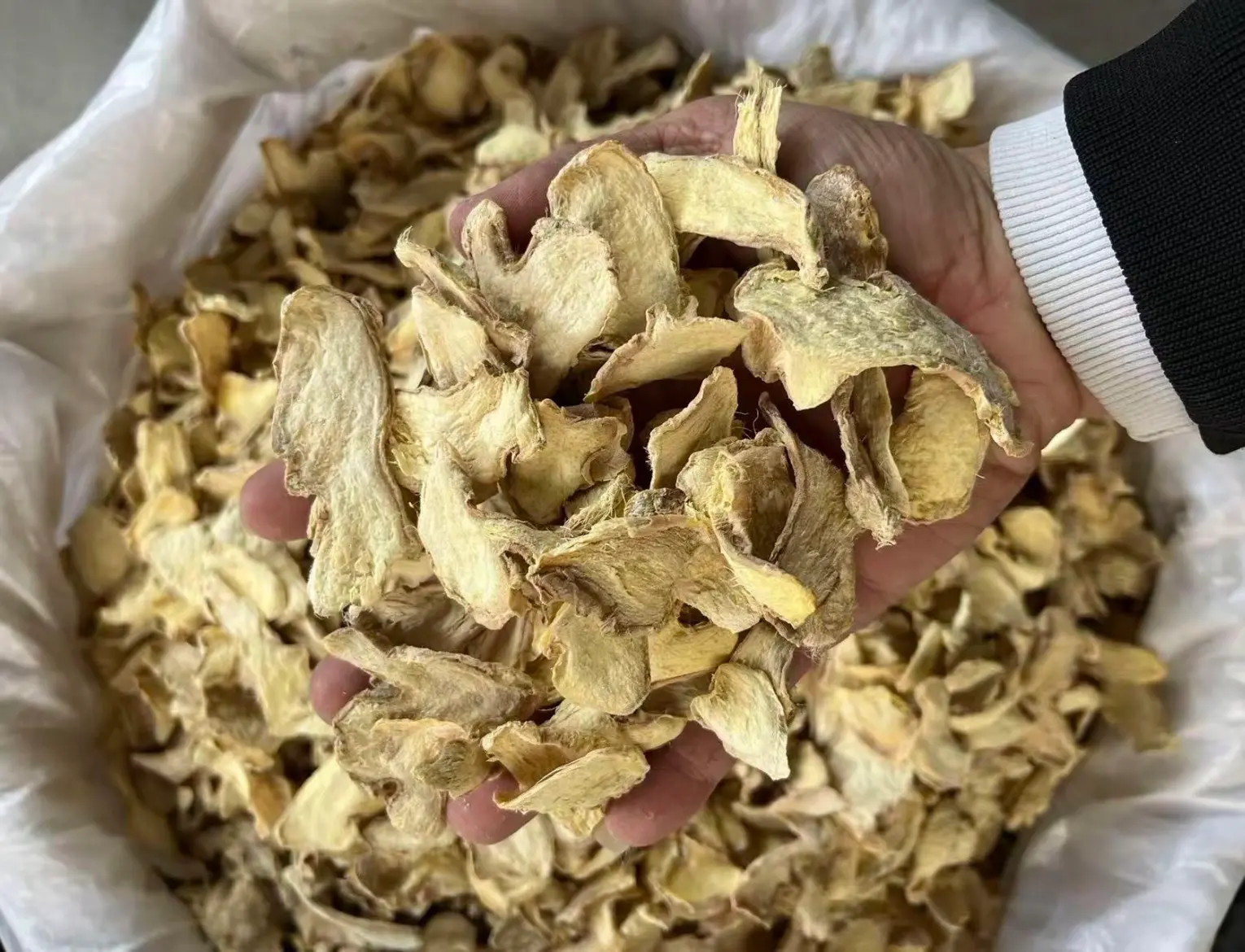
Representative dried ginger slices

PRACTICAL TIPS

Five choices that define dried ginger slices

Five choices that define dried ginger slices
ChoiceWhat to expectTypical fit
Yunnan small yellow ginger (Luoping)Small, thick, dense, pale-yellow slices with fine fibre; a rich, lasting heat and a sweet finish.Flavour-led drinks, infusions and premium food use.
Shandong large ginger (Laiwu, Anqiu)Large, thin, whitish slices with coarser fibre; milder and more watery; about 30% cheaper.Foodservice and processing.
Guizhou and SichuanMid-grade slices at a middle price.Price-led food use.
Slice thicknessThin 1–2 mm, medium 2–4 mm, thick 4–6 mm.Our reference is 2–4 mm; state the range you need.
Drying routeSun-dried for 5–7 days; export hot-air drying at 60–70 °C for 12–16 hours; freeze-dried keeps the most aroma at 2–3 times the price.Hot-air drying for consistent export lots.

China is not the only ginger origin

India grows the most fresh ginger in the world, and China exports the most dried ginger. Vietnam's mountain areas next to Yunnan (Lao Cai, Ha Giang, Cao Bang) grow small, pungent ginger similar to Yunnan's but sorted more roughly, and it reaches Yulin across the border at 15–25% below Yunnan bulk. Kerala in India grows old, high-aroma ginger for fragrance and medicinal use. Indonesian ginger is thick-skinned, hot and slightly bitter, and goes mostly to oil extraction.

So the useful question is not which country, but which slice: the aroma, size, cleanliness, processing, documents and price your product needs.

When new-crop ginger arrives

China lifts fresh ginger from October to December, mainly in November (Yunnan earlier, Shandong later), and dries it from November to February. Farmers can keep fresh ginger in cellars for one to two years and dry it when prices improve, so slices are available all year; new-crop slices trade at a premium over old crop. Vietnam harvests from September to November and India from November to February.

Drying and sulphur

Sun-dried slices are washed, cut 2–4 mm thick and dried for 5–7 days to 12% moisture or less; Yunnan's dry weather takes 4–5 days, humid Shandong 6–8. Export processors steam-blanch the slices and dry them with hot air at 60–70 °C for 12–16 hours, which gives more even lots.

Some low-grade slices are fumigated with sulphur while half-dry, to look brighter and resist mould. They trade about 20% below sulphur-free slices and carry a sulphur dioxide risk. Skins and broken pieces are milled or distilled at 30–50% of whole-slice value.

Quick checks on a sample

What Kun and Chuangui check first at our Yulin desk. The laboratory then confirms moisture, oil and sulphur dioxide.

Snap

A dry slice is crisp and firm and breaks cleanly. A soft or light slice is damp.

Colour

Natural yellow-brown is right. Very white or bright slices suggest sulphur, dark ones age or scorching, and reddish ones spoilage.

Smell

Break a slice and smell for clean ginger. Sour, mouldy or sulphur notes are warning signs.

Middle and bottom of the bag

Fragments, skins and damp slices tend to settle there, so sample from the middle and bottom, not only the top.

Price index, September 2026

Yulin market prices for dried slices as an index, with Yunnan bulk slices = 100; not offers. Yunnan slices lost about 40% of their price between the 2023 peak and 2024, and recovered slightly in 2025.

Yunnan bulk slices

100

Yunnan selected small yellow ginger

about 120

Guizhou bulk slices

about 85

Shandong bulk slices

about 80

Vietnamese sulphur-free bulk

about 80

QUICK CHECK

For a dried ginger enquiry

  • Origin style: Yunnan, Shandong or another stated origin
  • Slice thickness and piece range; selected or bulk
  • Sulphur-free requirement and SO₂ limit
  • Moisture (12% or less is usual) and foreign matter
  • Tests and documents for your destination
  • Packing, quantity and destination

The origins, prices and differences on this page come from our team's trading in Yulin and are dated. The approved sample, the specification and the lot certificate decide the order.

BUYER QUESTIONS

Frequently asked questions

Yunnan or Shandong ginger: which should I choose?

Yunnan small yellow ginger gives small, thick, dense slices with a rich, lasting heat and a sweet finish. Shandong large ginger gives larger, thinner, milder slices at about 30% less. Choose Yunnan for flavour-led drinks and infusions, Shandong for volume and processing.

Can I get sulphur-free ginger slices?

Yes; specify it. Sulphur-free slices cost about 20–25% more in Yulin, and the sulphur dioxide result on the lot certificate confirms them.

Is galangal the same as ginger?

No. Galangal is a different plant in the same family, grown mainly in Guangdong (Xuwen), Guangxi (Qinzhou) and Thailand, with a sharper, camphor-like heat. It is traded separately.

Why does the ginger price move so much?

Fresh ginger can be stored for a year or two, so farmers hold it back when prices are low and release it when they rise, and planting follows price. Yunnan slices lost about 40% of their price between 2023 and 2024.

Can you supply ginger powder?

Yes, through a processing partner, once the mesh, microbiology, packing and terms are agreed. Ask what the powder is milled from: skins and broken pieces are worth 30–50% of whole slices.