Commercial grade
Whole Star Anise — product sheet
Whole star anise for export food, beverage, spice blending and extraction requirements.
Public reference specification
Public reference specification | Parameter | Published reference | How to verify |
|---|
| Typical pod diameter | 3–5 cm | Measure and record the identified sample |
|---|
| Colour | Brown to maroon | Check and record against the agreed specification |
|---|
| Broken rate | max 5 % | Check and record against the agreed specification |
|---|
| Foreign matter | max 0.5 % | Check and record against the agreed specification |
|---|
| Moisture | max 12 % | Request a laboratory test tied to the identified sample or lot |
|---|
| Visible mould | None | Check and record against the agreed specification |
|---|
| Total ash, dry basis | max 4 % | Request a laboratory test tied to the identified sample or lot |
|---|
| Acid-insoluble ash, dry basis | max 0.5 % | Request a laboratory test tied to the identified sample or lot |
|---|
| Volatile oil, dry basis | min 7.5 ml / 100 g | Request a laboratory test tied to the identified sample or lot |
|---|
| Sulfur dioxide (SO₂) | max 30 mg/kg | Request a laboratory test tied to the identified sample or lot |
|---|
| Origin | Yulin, Baise, Fangchenggang or Wuzhou, Guangxi, depending on the offered lot | Check the supplier record and lot identity |
|---|
| Form | Whole dried fruit | Match the identified sample to the written order |
|---|
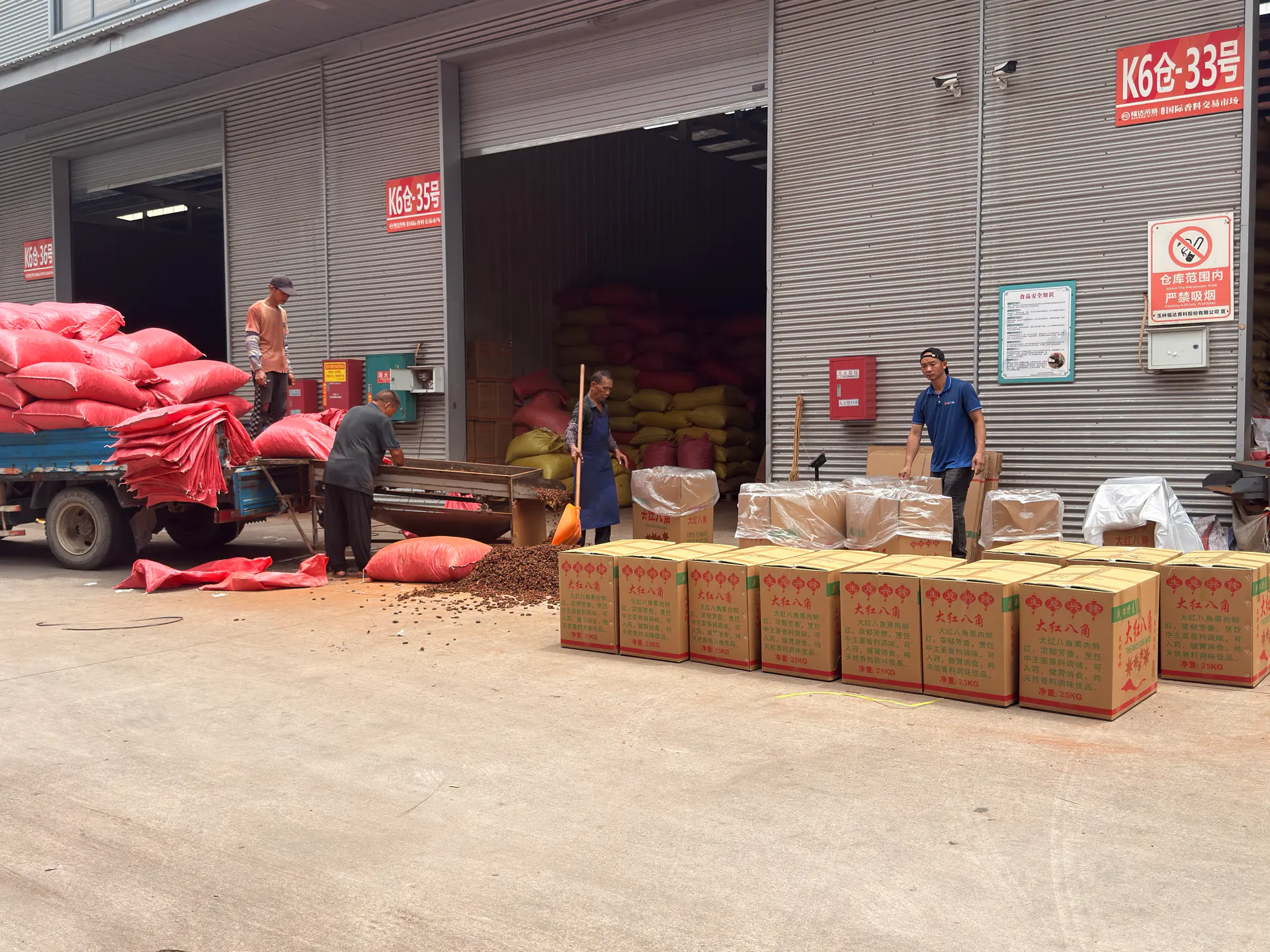
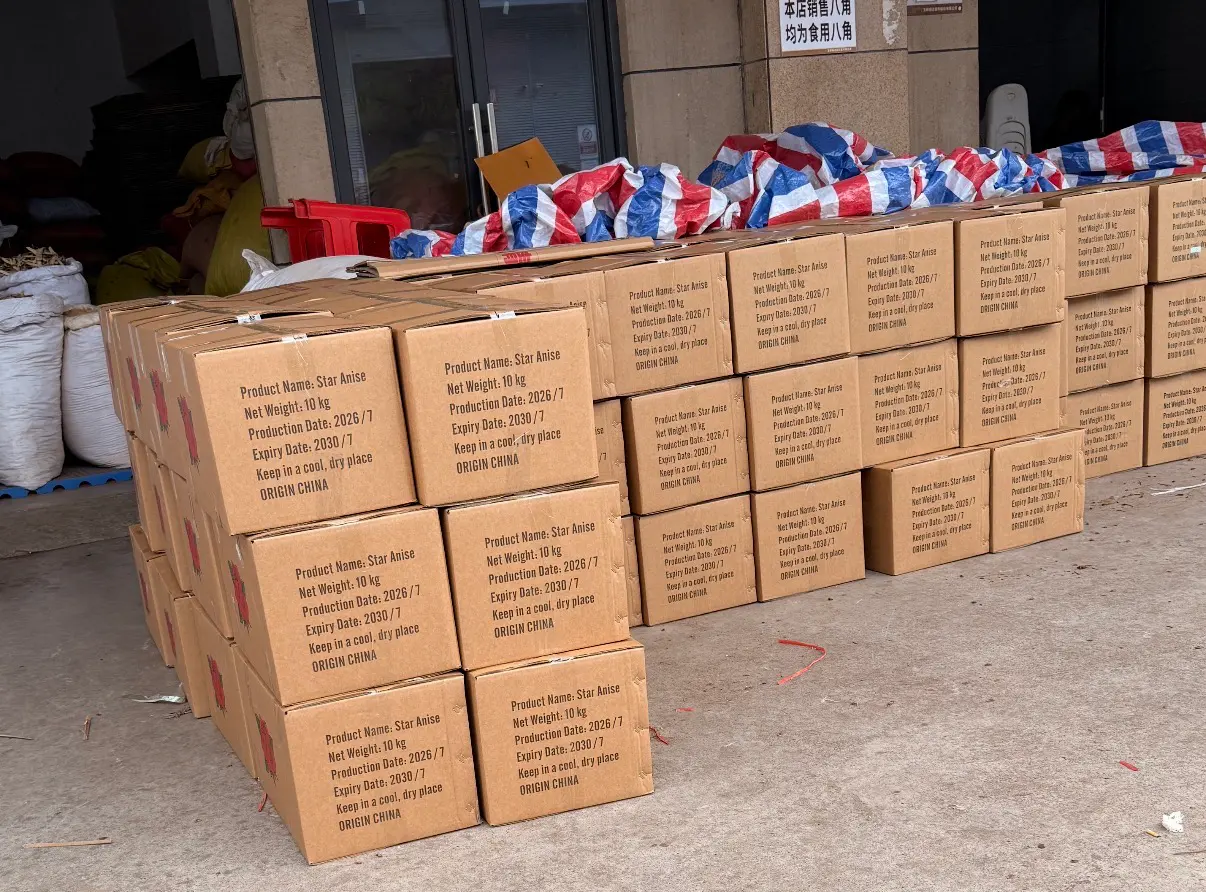
| Packaging | 10 kg, 20 kg or 25 kg lined export cartons, confirmed in the quotation | Match the packing specification to the packing check |
|---|
Reference values, not results for a specific lot; the agreed specification and your lot’s test decide.
Commercial details
- Botanical name
- Illicium verum Hook. f.
- Origin
- Yulin, Baise, Fangchenggang or Wuzhou, Guangxi, depending on the offered lot
- Form
- Whole dried fruit
- Typical uses
- Food · Beverage · Spice Blending · Extraction
- Minimum order
- 500 kg
- Packaging
- 10 kg, 20 kg or 25 kg lined export cartons, confirmed in the quotation
- Shelf life
- Confirmed for the offered product and packing
- Storage
- Store cool, dry and clean; protect from moisture and strong odours.
Buying adviceState the crop (autumn Dahong or spring), the share of open stars or grade, the sulphur-free requirement and SO₂ limit, the moisture limit, destination tests, packing and quantity.
AssessmentAssess pod diameter, appearance, wholeness, moisture, foreign matter and visible condition against the identified sample.
Sample recordSample reference and date, product photographs, inspection checklist and packing photographs.
Technical referencesISO 11178:1995 · GB/T 7652-2016 — current Chinese standard · GB/T 7652-2026 — effective 2026-10-01
How we grade this
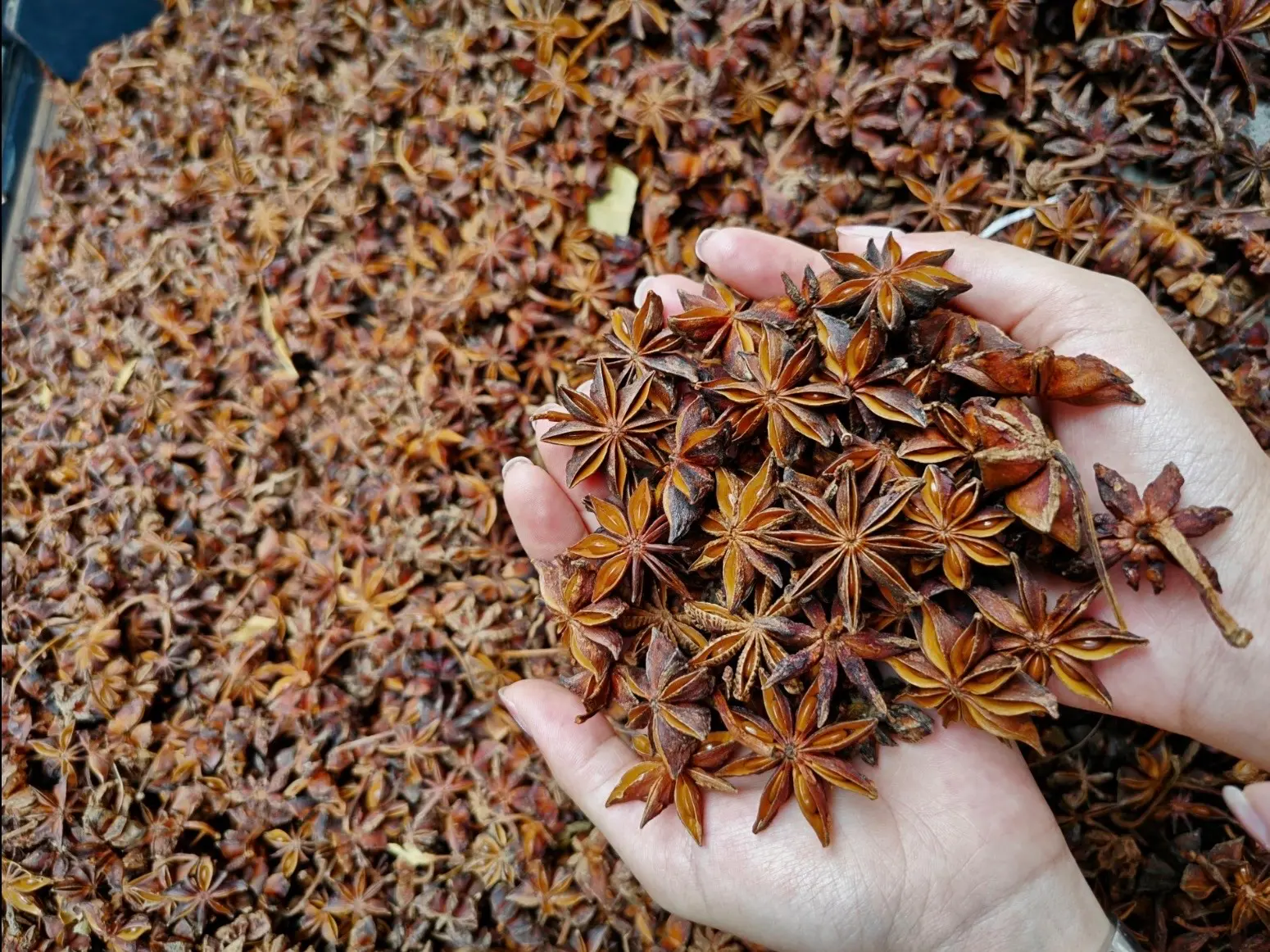
Kun and Chuangui start with the hand. They squeeze a handful and let go: dry fruit is crisp and prickly and does not stick, while soft, pliable fruit is still damp. Then they look at fullness and opening. Grade-1 autumn fruit is plump and wide-lobed, more than 80% of the stars are open, no star is black or mouldy, and broken lobes, stems and impurities stay at or below 1.5%.
Next come smell and taste. They break a star and smell deeply for a clean, sweet anise aroma. A sour or chemical note suggests sulphur treatment, a burnt note over-drying and a musty note mould. A chewed piece should finish sweet, not bitter or harsh. Finally they weigh a litre: Guangxi autumn fruit comes in at about 280–300 g, spring fruit at least 20 g lighter. Lots that fail these checks are not offered. The laboratory then confirms moisture, volatile oil and SO₂, and origin comes from the supply records, never from the look of the fruit.
Frequently asked questions about Whole Star Anise
Is this autumn or spring star anise?
The crop is stated for each lot. For whole-star export we recommend Guangxi autumn fruit (Dahong), picked from August to October. Spring fruit, picked from February to April, is smaller and thinner and better suited to grinding.
Is your whole star anise sulphur-free?
Our reference specification sets sulphur dioxide at 30 mg/kg maximum, and every export lot is laboratory tested before shipment. Sulphur-treated fruit, often bright and sour-smelling, does not meet it.
How big are the stars?
Typically 3–5 cm across. China's grade-1 Dahong allows up to 850 stars per kilo; tell us if you need a count per kilo for your pack.
Which part of Guangxi does it come from?
Yulin, Wuzhou, Fangchenggang or Baise, stated for each lot. Old seed-grown trees give thick, oily fruit; young grafted groves, common in Baise, give more uniform but thinner fruit. We grade the fruit, not the county name.
When is new-crop fruit available?
Guangxi autumn fruit is picked from August to October and graded from late August. Outside that window, whole stars come from stock, and we state when the lot was picked.